[Project] ClarityAI Intelligent Requirement Alignment Tool
When you are using AI to generate code, solutions, or content, do you often encounter scenarios like this:
You wrote a long list of requirements, but AI gave a completely off-track answer;
You repeatedly revise the prompt, but the generated result always “misses the mark”;
You think you have made yourself clear, but AI understands a different version...This is not because AI is not smart enough, but because your requirements are not yet “structured” enough.
ClarityAI was born exactly for this — through multiple rounds of intelligent Q&A, it helps you organize scattered ideas into a logically clear and detailed requirements report, so that any downstream AI can accurately understand your intent.
Usage Instructions:
I have deployed the backend on my own server, and you can access and use it directly:Link directly to ClarityAI
Due to limited funds, I have set a daily token usage limit. If the limit is reached, please“Settings”enter your own API BaseURL and API-Key
Usage Example

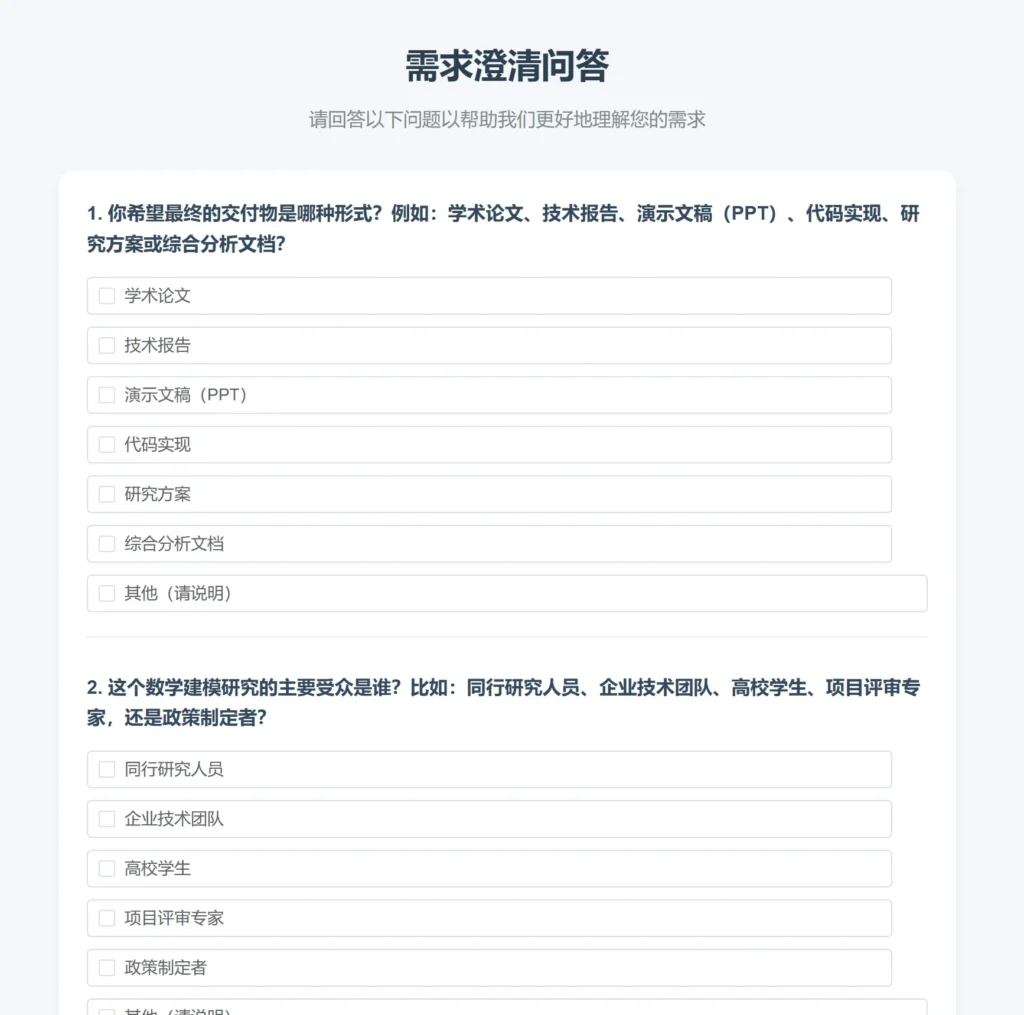
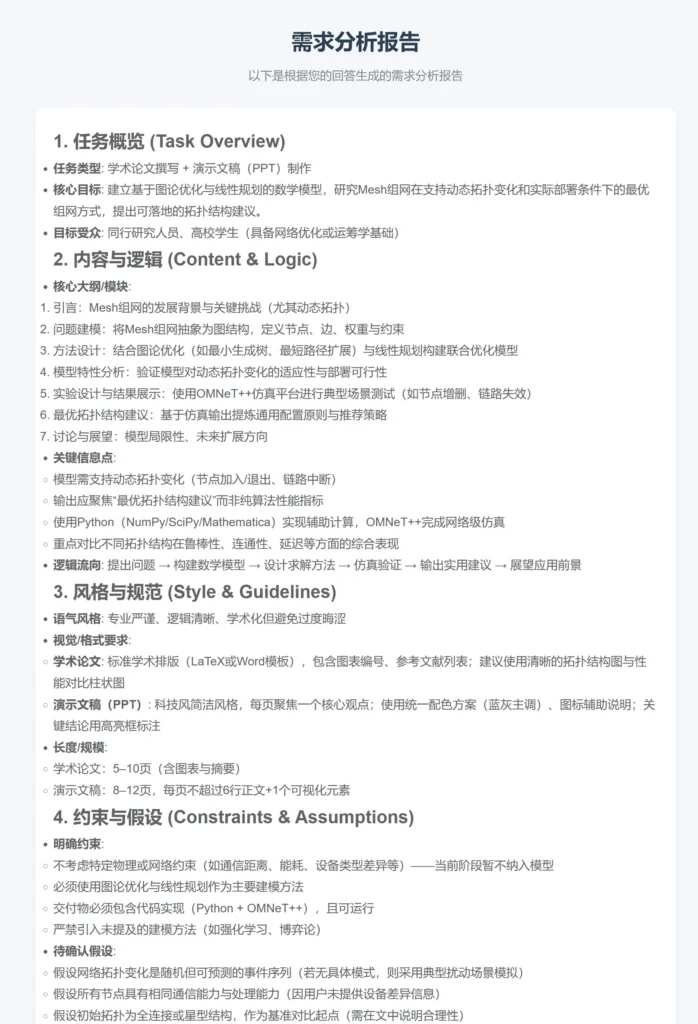
I. Pain Point: The “Generation Gap” Between Users and AI”
We are in an explosive period of AI applications. From code generation and copywriting to product design, everyone wants to use AI to improve efficiency. But a common misconception is:We often overestimate our ability to express requirements, and underestimate the threshold for AI to accurately understand vague language.
- You say “make an app similar to Xiaohongshu but more concise,” and AI may understand it as “remove some features,” but your definition of “concise” is “minimalist design style, keeping only image and text sharing”;
- You say “write a crawler in Python,” and AI gives you a general framework, but you forgot to mention that it needs to handle anti-crawling, store data in a database, and run on a schedule;
- You say “generate a market analysis report,” and AI outputs according to a template, but you did not clearly say whether the target audience is investors or an internal team, resulting in a completely wrong focus in the report.
The result is:The content output by AI does not meet expectations → repeatedly revise the prompt → spend a lot of time → in the end you may still have to rewrite it manuallyThis is not because AI capability is insufficient, but because we lack atransform vague requirements into precise instructionsmiddle layer.
The role of ClarityAI is exactly this middle layerIt does not directly generate the final product. Instead, through systematic questioning, it guides you step by step to supplement key information such as functional boundaries, technical constraints, user scenarios, and priorities, and finally outputs astructured requirements reportThis report can be directly fed to any downstream AI (such as ChatGPT, Claude, Copilot, Midjourney, etc.), enabling them to give results more aligned with your original intent based on complete context.
II. Product Positioning: A Generator of Requirements Reports, Not the Final Deliverable
The core value of ClarityAI is not to replace AI, but toenhance the communication efficiency between you and AIIt is like a professional requirements analyst, helping you organize the “tangled mess” of ideas in your head into a clearly structured requirements document.
- Input: A simple idea (for example: “I want to make a WeChat mini-program that helps users keep accounts”)
- Process: Multiple rounds of dynamic Q&A (covering dimensions such as user personas, feature list, technology selection, data privacy, and iteration plan)
- Output: A detailed requirements report in Markdown format, including sections such as background, goals, feature descriptions, non-functional requirements, and acceptance criteria
This report can be directly pasted into a chat window and sent to any AI as an advanced prompt, letting it generate code, design drafts, solutions, or copy; it can also serve as an internal team requirements specification for subsequent development.
III. Technical Architecture: Vue 3 + Flask, Lightweight and Efficient
The project adopts a front-end and back-end separation architecture, with code repositories stored separately, making independent deployment and expansion easy.
Frontend — ClarityAI-Frontend
Based on Vue 3 + Vite + Element Plus, focusing on interaction smoothness and interface clarity:
- Core dependencies: Vue 3.5.27, Vite 7.3.1, Element Plus 2.7.7, Pinia 3.0.4, Vue Router 5.0.1
- Markdown rendering uses
markdown-it, and the results page clearly displays the report - Main Pages:
- Home: Enter a preliminary idea and launch the requirement clarification process with one click
- Q&A Page: Displays AI dynamically generated questions (single choice/fill-in-the-blank/essay), answer one by one
- Results Page: Renders the complete requirement report, supports downloading Markdown, and generates a share link
- Overview Page: Displays the entire conversation and report versions as a timeline for easy backtracking
Backend —— ClarityAI-Backend
Based on Flask 3.0.3, provides a RESTful API, and integrates Qwen (Tongyi Qianwen) or OpenAI as the intelligent engine:
- Database: SQLite (lightweight, ready to use out of the box)
- AI interface: Supports dynamically generating questions, continuing to ask follow-up questions based on answers, and summarizing to generate the final report
- Security and cost control: Supports daily Token quota configuration to avoid API cost overspending
Main API endpoints:
GET /api/health # Service statusIV. Core Process: Three Steps to Generate a High-Quality Requirement Report
Step 1: Enter your raw idea
Write your roughest idea in the input box on the home page, even if it is only one sentence. For example: “I want to build an online education platform.”
Step 2: AI-guided Q&A
The backend AI will automatically generate a set of clearly structured questions based on your input, and may cover the following according to your idea:
- Target users: Who will use it? What are their pain points?
- Core features: Must-have features and nice-to-have features?
- Technical preferences: Is there a specified tech stack? Are there performance requirements?
- Resource constraints: Time, budget, team size?
- Success criteria: How do you measure whether the final outcome meets the standard?
Question formats include single/multiple choice, fill-in-the-blank, and open-ended narrative questions. After you complete one round of answers, you can also choose “Continue refining,” and the AI will generate deeper questions based on the existing answers until you feel the requirements are clear enough.
Step 3: Generate a requirement report and use it for downstream AI
After all Q&A is completed, the backend will automatically summarize all information and generate a structured Markdown report. The report includes the following typical sections:
- Project overview(Background, goals)
- User roles and scenarios(Who uses it under what circumstances)
- Functional requirements(Priority classification)
- Non-functional requirements(Performance, security, compatibility)
- Technical constraints and dependencies
- Acceptance criteria
You can directly copy this report on the results page and paste it into the dialog box of other AI tools as a Super Prompt. For example, copy the report content and send it to a code generation AI, and it will generate a more accurate code skeleton based on the complete requirement description; send it to a design AI, and it will produce a design draft with a better matching style.
V. Quick Local Deployment
# BackendVisit http://localhost:5173 to experience it.
VI. Use Cases
- Individual Developers: Before using AI to assist in generating project code, use ClarityAI to clarify requirements first
- Product Managers: Quickly produce a draft requirements document as a basis for team discussion
- Entrepreneurs: Transform your business ideas into executable specifications
- Heavy AI Users: Reduce back-and-forth with AI through high-quality requirements reports
Conclusion
ClarityAI does not attempt to replace any AI, but rather to “show the way” for AI. In today's world where AI capabilities are increasingly powerful,clear input is more important than complex prompt engineering techniquesBy transforming vague ideas into structured requirements, ClarityAI makes your conversations with any downstream AI more efficient and more precise.
If you have also experienced AI “failing” because requirements were not clearly stated, give ClarityAI a try. Welcome to visit the GitHub repository, give it a Star, and we look forward to your Issues!
- Frontend:kazuky233/ClarityAI-Frontend
- Backend:kazuky233/ClarityAI-Backend